

⛫ Crumbl's Next Chapter...
The co-founders are stepping down

To Empire Builders,
With the news this week that Crumbl’s co-founders are stepping down, in today’s edition I dive into Crumbl’s journey from their founding, to present day.
What started as a side-hustle in 2017 (the 1st location had just a 6 month lease!), became a ~$2B+ cookie franchise in the span of ~7 years.
There’s lessons to be learned from what the founders did well, and maybe not so well.
I also share my recently released interview with a 25 unit Jersey Mike’s operator, who also bought the entire state of Minnesota for a new brand 👀.
Let’s dive in 🫡
If you were forwarded this email, consider subscribing below.
What’s on My Mind 🧠
Where Next for Crumbl?

Crumbl Co-Founders: Sawyer Hemsley (left), Jason McGowan (right)
Crumbl started as a side project for co-founders & cousins Jason McGowan and Sawyer Hemsley.
Jason had a job at Ancestry, and Sawyer was in grad school, but the duo decided it would be fun to have a side hustle.
They never imagined it would become what it has today…
Origins
Location #1 was in Logan, Utah.
Apparently, the location was set to be demolished in six months, so their original lease wasn’t even for a full year! Jason and Sawyer signed the lease and ordered baking equipment before they even tested a single cookie recipe.
They quickly learned they weren’t great at making cookies themselves, so they hired a local chef to show them the fundamentals of baking.
Due to Jason’s background in social media and tech as a UX Designer, they began “A/B testing” their chocolate chip cookie recipes at gas stations, with family, friends, etc.
Eventually, they launched with what they believed was the best chocolate chip cookie on the market, and the rest is history.
That single store with just a few cookie options evolved into the weekly rotating menu we know today, that’s available at over a thousand locations in the US…
And from what I can gather, they’ve bootstrapped the entire way!
Growth
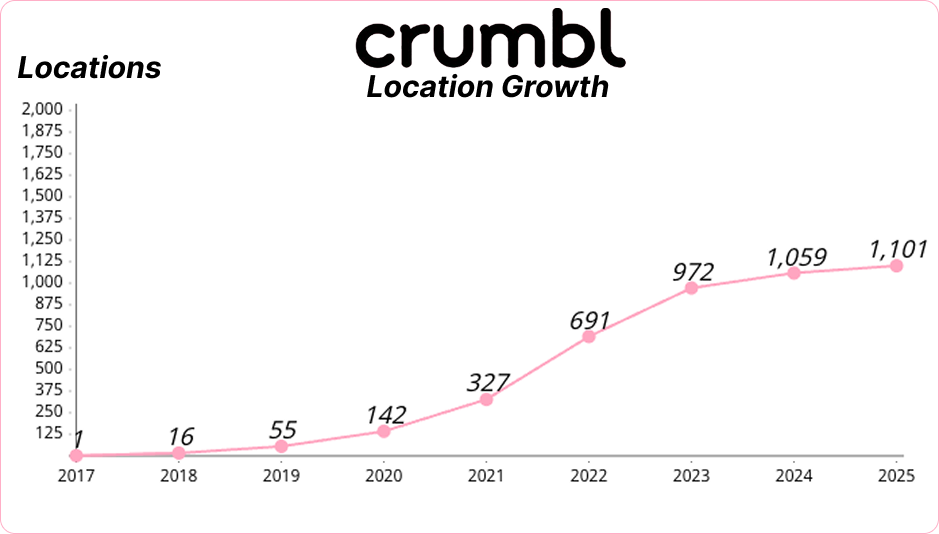
Crumbl launched franchising within a year of their founding, after only operating a single store (usually not the best idea….but the chart speaks for itself as this brand has clearly been a rocket ship).
And it can’t be overstated how big a role social media & tech played in their ability to do this.
Social Media
Food content creators weren’t prevalent ~7 years ago like they are today, but Jason and Sawyer recognized when they posted videos on Instagram, that people were engaging with the content.
They also were already aware of TikTok, which was founded in 2016, and were bullish from the get-go the platform would be a game changer (easy to say it was obvious now, but to make that call pre-covid is impressive).
Their decision to go all in on video content in the 2018-2019 time frame was perfect timing - it was early enough to have little competition from legacy brands, but not too early that there was no engagement.
While the timing was a major advantage you can’t replicate today, the biggest factor is their team (led by Sawyer on the marketing side).
I can’t emphasize that enough - the only thing I study as much as franchises is the art of content creation on different platforms - and Crumbl is elite at content.
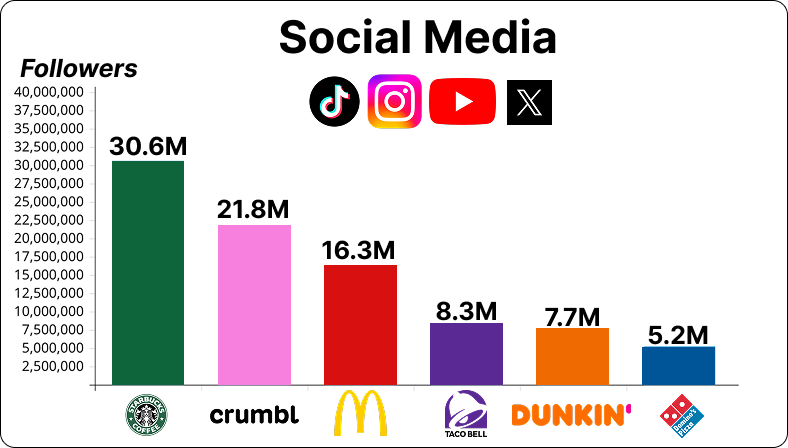
They don’t mass upload single pieces of content across Instagram, TikTok, YouTube, etc. They tailor their content to each platform based on what performs best natively - which any creator worth their salt knows that’s what you have to do.
Again, today that might be common industry knowledge, but to have the savviness to recognize this in 2018, and then go execute, is brilliant.
It’s why they’ve outperformed nearly every legacy brand (minus Starbucks) across platforms.
This viral social media marketing undoubtedly drove foot traffic to stores. In my podcast conversation last year with 13-unit Crumbl owner Taylor Byington, he reflected on the early days:
Our doors would open at 8:00 in the morning, and we would have a line start forming at 6:00 to 6:30 every morning, and that was almost every day.
Once customers walked into stores, everything they engaged with from a technology perspective, was custom made by Crumbl HQ - the point of sale, mobile app, etc.
Technology
By owning their entire tech stack, Crumbl has internal dashboards that provide visibility over nearly every aspect of a franchisees business -
Baking times
Speed of service
Delivery service
Product availability
etc. etc.
All of this manifests in custom KPI dashboards for franchisees that tells them exactly how they’re performing relative to the rest of the system.
Many franchisors should take note that transparent data sharing is a major lever you should be pulling to help make everyone better!
As far as building tech however, 9/10 times, it’s a bad idea for an emerging franchise to try it. Scaling a franchise & supporting operators is hard enough…building tech alongside it is a monster challenge. Crumbl is the exception, not the rule.
Jason had a background in engineering already, and was able to recruit a senior engineer from Facebook as their CTO when they had just two locations (his name is Bryce Redd by the way, and he is also stepping down alongside Jason & Sawyer).
These guys were so dialed into tech that as early as 2022, they’ve had artificial intelligence scanning customer pictures of cookies, to then send quality scores to their franchisees.
This is why they were able to grow the way they did. Their tech gives them insights to know if a franchisee is underperforming before it really hits the P&L in a significant way.
So for their first handful of years, Crumbl the franchisor was winning, and so were franchisees.
But at a certain point…that changed.
Troubles
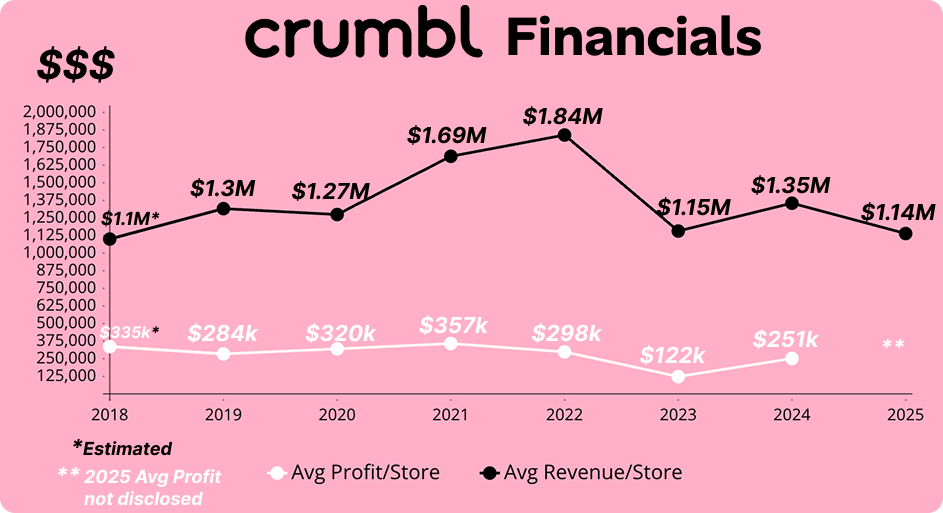
I’d argue the peak of Crumbl (thus far) was 2022. Their average profitability wasn’t as high as the prior year, but they finished that year with 691 stores, over 2x what they had in 2021.
As you can see from the chart, their average unit volume and average profit have swung wildly since then.
It’s no wonder in 2023 they rebranded from Crumbl Cookies to just Crumbl, and began launching non-cookie products for the first time.
In the most recent FDD that discloses 2025 performance, Crumbl reported their lowest average unit volume since 2018, and didn’t report profit for the 1st time ever.
Both of these facts are obvious indicators of volatility within the brand.
Side note: a lot of people have enjoyed criticizing Crumbl for the recent FDD, but it’s worth remembering ~90% of franchises don’t disclose any profit data and never have.
All this to say…rapid growth comes with quite a bit of risk, and I think it’s easy to see Crumbl has over-expanded at the expense of franchisees.
I’m not sure how HQ analyzed markets to determine what the TAM of this concept is in America, but as of today, their calculus is off.
To make matters worse, the novelty value that used to drive foot traffic is tapped out, and the broader restaurant industry is facing a recession.
They’ve closed 26 stores since 2023, and frankly, probably need to close more to right size their unit count so franchisees can have stable economics.
What happens next?
TSG Consumer Partners, who invested in the brand last year at a ~$2B valuation, have a big project on their hands to steady this ship.
Whoever takes over needs to have the ability to build upon the social media and tech foundation that’s made this brand thrive at times.
But more than that, Crumbl needs to evolve into something that consistently sells more than just cookies.
A stable second category would do wonders for franchisee economics, and brand optics, as they’re now routinely criticized for their calorie/sugar volume per cookie.
While certain folks within the industry are rooting for them to fail…
A) I never root for brands to fail bc it implicitly means you’re rooting for franchisees to fail, and seeing people lose their hard earned money is brutal
B) Crumbl isn’t going anywhere
Legacy cookie concepts (the first 3 brands following Crumbl below) have been operating for anywhere from 2-4 decades, and still have hundreds of locations.
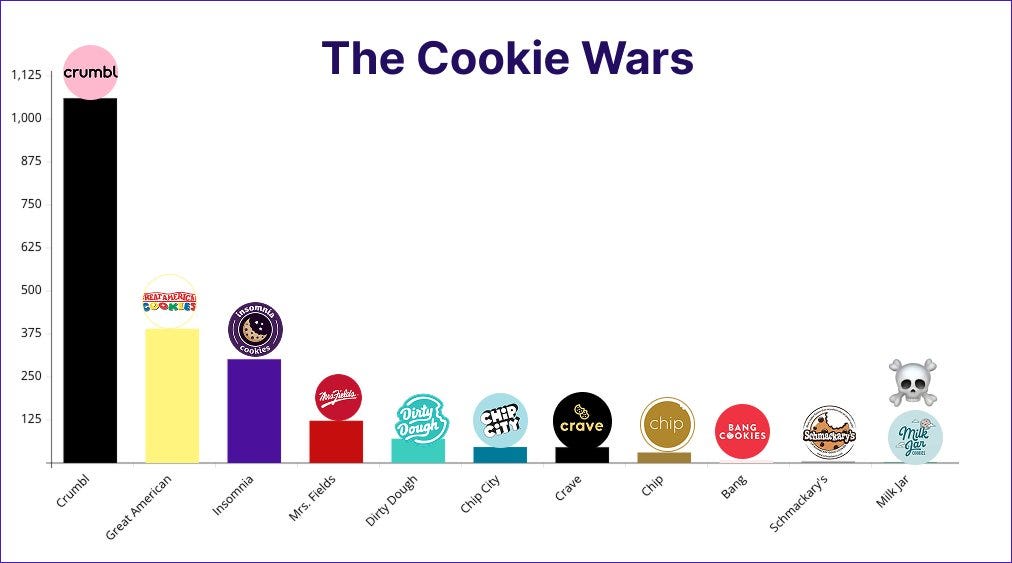
Does a right sizing need to happen? Absolutely . What that unit number is can be debated.
But can Crumbl have a 2nd act? Yes.
It just won’t be Jason and Sawyer leading them, but those two deserve credit for creating a modern blueprint for franchising.
I’ve often wondered what this duo could accomplish if they chose a category that was subject to less volatility.
In Jason’s announcement that they’d be stepping down, he did say “excited to get back to Founder Mode with Sawyer Hemsley…”
Perhaps their own 2nd act is already in motion.
Live on Empires 🎧
Building Jersey Mike’s
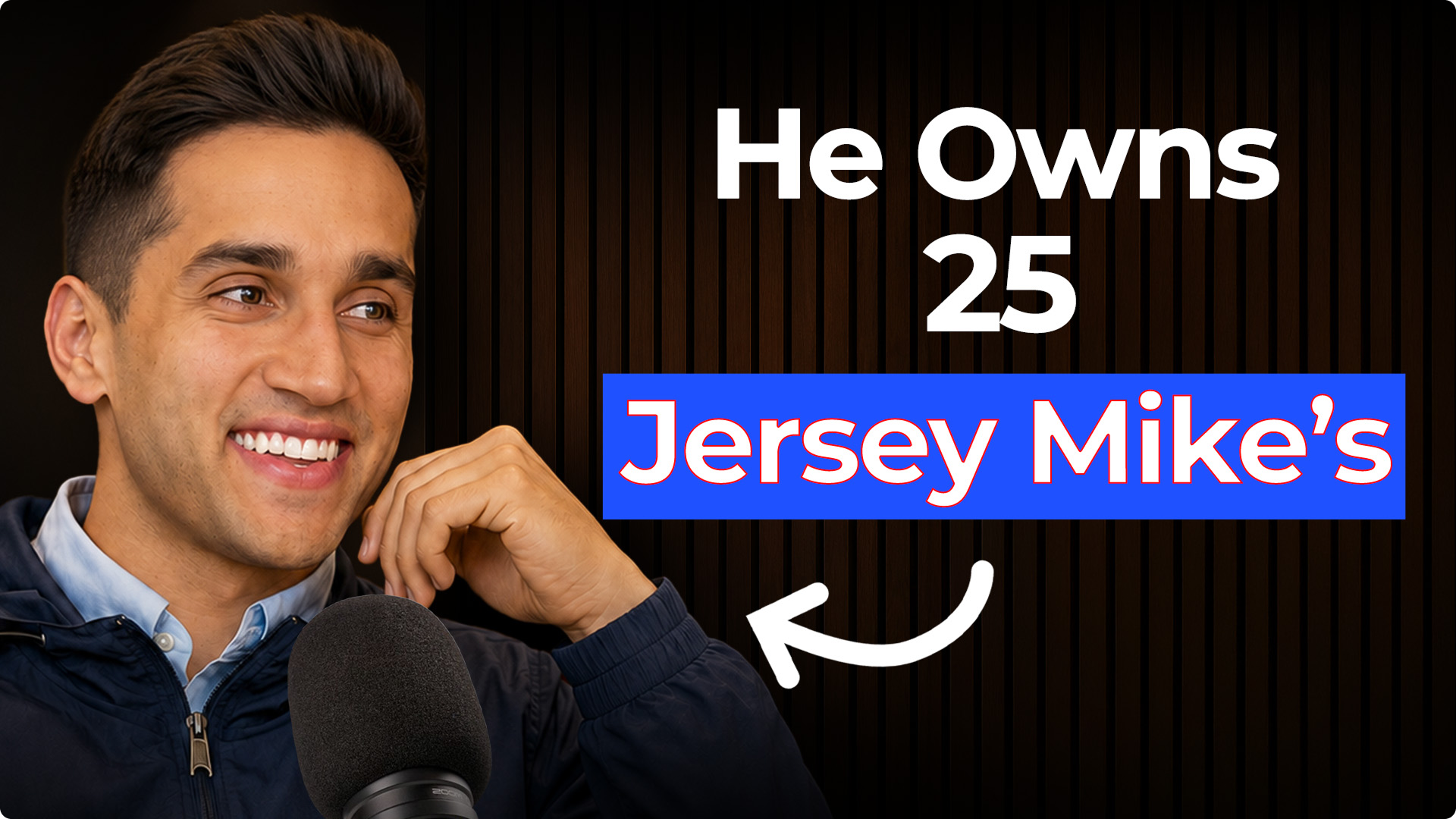
Alongside his father and brother, Kavrin McGuire operates 25 Jersey Mike’s locations across Minnesota & Wisconsin.
They also bought the entire state of Minnesota for Mike’s Red Tacos, the franchise backed by the early Dave’s Hot Chicken team.
Learn more about Mike’s Red Tacos via my past newsletter here.
My favorite part of this conversation was the incredible insights Kavrin gave on Peter Cancro and the type of culture he built.
Check out the conversation below, available on all podcast platforms!
QSR Corner 🍔
Inspire Brands Files for IPO
The parent company of Dunkin’ and Buffalo Wild Wings is the latest franchisor to announce a confidential filing to go public.
Swig Expanding to Colorado
The dirty soda brand is pushing for national growth as legacy QSRs join the beverage trend.
Dunkin’ is heading to Canada (again)
Foodtastic, a major Canadian foodservice operator, will help Inspire Brands’ doughnut maker invade Tim Hortons’ home market.
Smoothie King CEO Launches Female Focused Fried Chicken Brand
CEO Wan Kim feels women want better quality and choice. Enter, Flock & Fresh.
Pizza Hut Franchisee Sues for Over $100M in Damages
Chaac Pizza Northeast, which depends on DoorDash to complete its orders, said the franchisor’s Dragontail AI system hurt its delivery sales and damaged operations.
Jack in the Box CEO is Out
In the midst of the “Jack on Track” program, the Board of Directors has appointed Mark King as Executive Chairman and Interim Chief Executive Officer.
McDonald’s is Removing Self-Serve Soda Fountains
The company plans to phase out the stations by 2032 as restaurants undergo remodels and modernization upgrades.
Best of the Rest 🧱
Hotels Q1 Performance is Up
In the first quarter of the year, hotel companies saw widespread U.S. RevPAR growth.
Re/Max has a new Owner
An $880 million franchise deal
Another Nine Announces $2M Investment
The indoor golf simulator franchise announced a $2 million investment round funded by existing investors.
That’s it for today’s newsletter, if you enjoyed it, please forward to anyone else in your network who would benefit or find it interesting!